I landed in Phnom Penh after an overnight flight exhausted. I keep doing these overnight flights because they’re cheap – but they’re miserable!! I took a tuk-tuk to the hostel I booked, and was surprised by how clean and westernized the city was. (Maybe it was because I was coming from India?) I stayed awake as long as I could, got pampered at a fancy salon next door, and then admitted defeat and took a nap. The hostel was very upscale as far as hostels go, and I had a “superior” private room that looked like it had been renovated recently with AC for $25. Not much converting currency here – they use US dollars for everything over $1. Any change under a dollar they give you Cambodian Riel, so you end up walking around with a jumble of Riel and US dollars at all times.
After my nap I went downstairs for dinner and while I was eating started talking to the girl next to me – Sarah. She had just arrived as well. She had been living and teaching in Thailand for 6 months, and needed to make a visa run out of the country so she headed to Cambodia for a week. We decided to meet for breakfast, and do some sight seeing.
Over breakfast the next day Sarah mentioned she just booked a private room for the next couple of nights since the dorms were fully booked. Fascinating – I also have a private room…. We agreed to share my room, and split the cost. AC accommodation down to $12.50 a night! More conversation – we were both headed to Siem Reap next, and the hostel just happened to have another location in Siem Reap. We booked bus tickets, and reserved a room to share in Siem Reap as well. While I was at it I left my passport with the hostel to send off for my Vietnam visa. Productive morning!
With that all sorted out, we got in a tuk-tuk to go visit the Choeung Ek Genocidal Center – one of over 300 killing fields of the Khmer Rouge. I had read about what had happened in Cambodia under the Khmer Rouge before coming, and knew it would be a heavy day, but felt it was almost a responsibility as a visitor to Cambodia. I won’t launch into a history lesson (there are much better resources for that) – but I will share some of what the tour was like. We were given a map and audio guide to listen to as we walked around the area, and were told in graphic detail about what took place at this site. There is a tall memorial building that you walk by as you enter and leave with the bones of the people executed here – sorted by type with different levels for skulls, and other large bones. An impactful introduction to the tour, and poignant last stop as you leave.
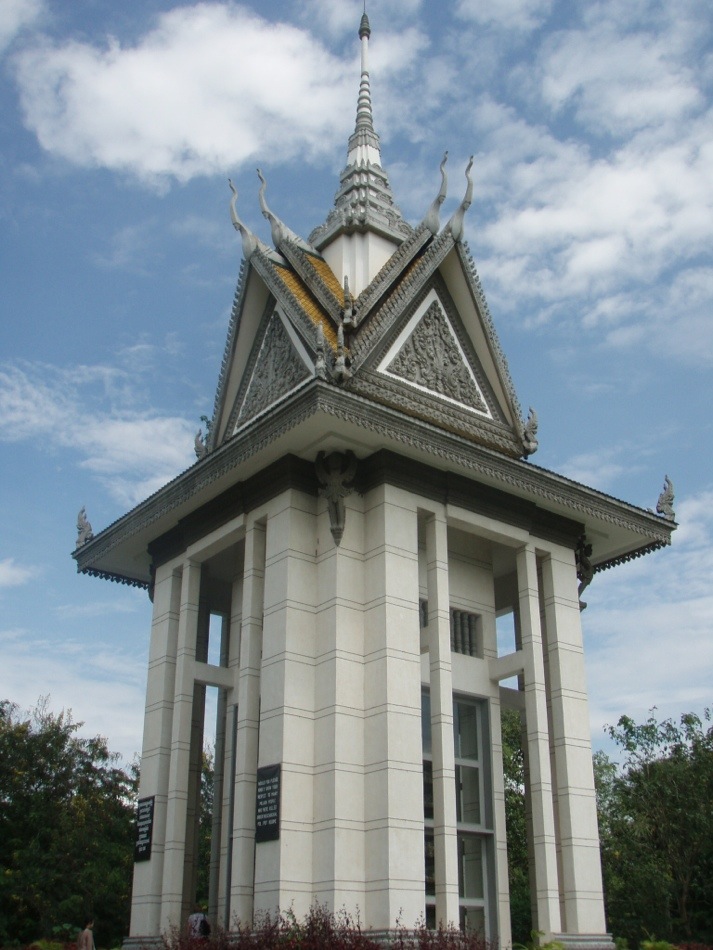

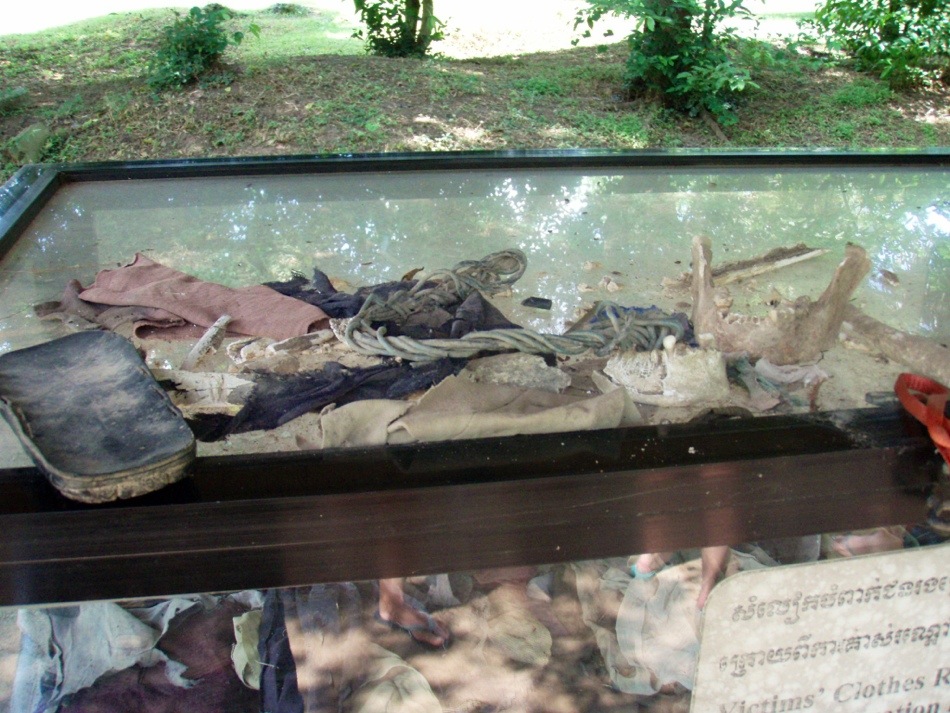
From the audio guide we heard about what would happen to people as they were brought in by the truck load. How they arrived almost starved and half dead already. How they were unloaded from the trucks, processed, and lined up in front of ditches to be executed, with Khmer Rouge propaganda blasting on loud speakers so people in the surrounding areas couldn’t hear what was going on. How they would poured DDT on the corpses in the open ditches to masque the smell. How there are mass graves that have been left undisturbed, and after rains new pieces of bones and bits of clothing continue to surface above ground. They are collected periodically, and left by a glass box that holds the clothing of victims previously found there.
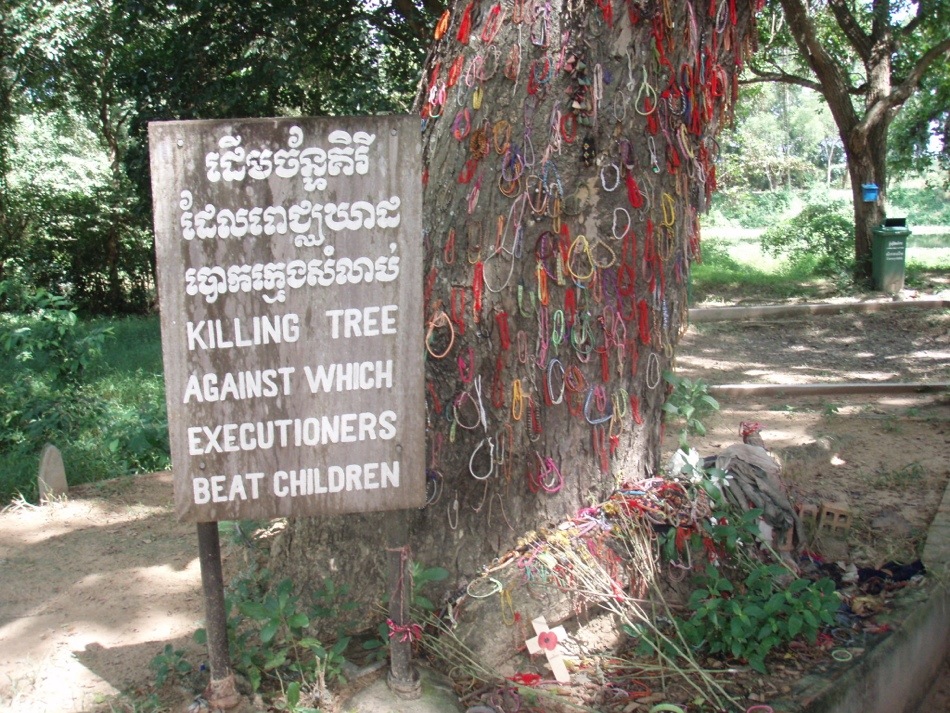
 There was one mass grave full of women and children. The Khmer Rouge policy was to kill the entire family of a “criminal”, so no relatives would be left to seek revenge. Next to this grave there was a tree with a bunch of bracelets visitors had left hanging off it. The audio guide explained that guards would swing the children by their ankles and smash their heads against the tree to kill them. A Khmer Rouge slogan – “Better to kill an innocent by mistake than to spare an enemy by mistake”.
 There were first person accounts of people who had been there, and at it’s partner S-21 – a detention/interrogation/torture center. The one that sticks out most to me was from a guy who had been been arrested and imprisoned as a very young teen. He told how while in prison criminals were forced to confess to wrong doing daily, and if they didn’t have anything real to confess to they had to make something up, or be killed. One night the boy couldn’t come up with any crimes to confess to. A fellow prisoner intervened, questioning the guards as to why the boy was there, saying that he was too young and had no idea what was going on. Another KR slogan “He who protests is an enemy. He who opposes is a corpse”. The fellow prisoner who intervened was executed, and surprisingly the boy was actually released. The narrator went on to say that he didn’t understand until he was much older why he was released, and that the man had stepped in knowing it would mean his own death. He went on to shamefully admit that he couldn’t remember the man’s name.
I couldn’t imagine living through that, and carrying the weight of it around with me for the rest of my life. For some reason while I listened to that particular story, I began to understand that the country is full of individual stories just like that – a mess of personal loss, torture, shame and horror. 25+% of the population was either killed, or died of disease, overwork and starvation. Everyone over the age of 38 (not much older than me) is old enough to have some memory of it, and everyone under the age of 38 lives in the shadow of it. The educated people were killed – doctors, scientists, monks, teachers, artists. No religion, no studies, no culture were tolerated. Foreigners? Killed. People turned against each other to survive, and children became executioners. By their own policy/precedent the Angkar should have killed themselves – they were college educated, and several had foreign ancestors. I walked around expressionless and numb, with tears streaming down my face.
From there we went to S-21. I think by now you get the picture, so I won’t go on.
I’m having a hard time following this up with stories about light hearted exploring, so I will close this post here.
 whereoutthere
Comments
No comments yet.